
Case Study
Wind turbine tilting mast: independent structural verification before manufacture
Structural verification of a client-designed 18m tilting mast, including finite element analysis, manual checks and formal substantiation report
Sprint
Renewable energy
Structural substantiation
FEA + manual calculations
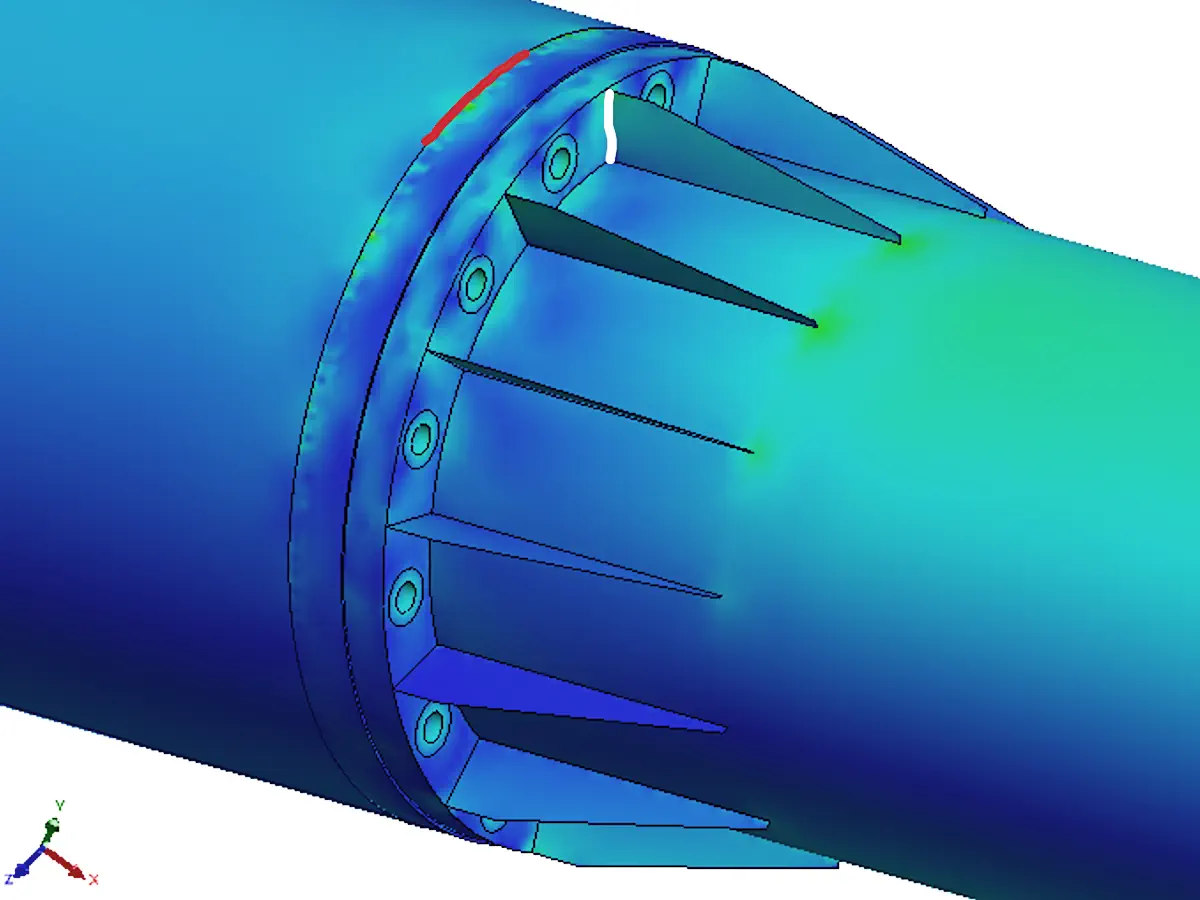
Example FEA stress plot from the structural report
Situation
The real problem
Constraints
-
Verification-only remit: the remit was to verify and substantiate a client-designed mast, not redesign any failing areas.
-
Multiple analysis scenarios: verification had to cover raised, lowered and critical-angle positions during maintenance.
-
Multiple assessment criteria: strength, deflection, reactions, utilisation / factor of safety, modal behaviour and fatigue all had to be assessed.
-
Hybrid FE modelling needed: the structure called for a mixed shell/solid model, multiple materials and realistic modelling of mass distribution.
-
Out-of-scope turbine geometry: the turbine was outside the main FE scope, but still needed representative mass and geometry for correct loading and modal results.
Client:
Wind turbine manufacturer
Role:
Mechanical engineering consultant
Period:
2024
Scope:
FEA-led structural verification +
Structural analysis report
Acceptance basis:
Client detail design +
Code-aligned substantiation +
Client / third-party approval
Key moves
Built a clean reference model and FE model suite
- Produced a 3D reference model from client drawings and 3D data for checking, measurement, illustrations and FE model generation.
- Built the analysis models needed for the different mast positions and verification types, including strength, frequency and fatigue.
Defined the load regime and ran the verification
- Derived the loading basis and applied it across the model suite for the relevant operational and maintenance conditions.
- Solved the models, then collated and reviewed the results to identify governing behaviours, critical details and any initial failures.
Fed back issues and re-checked the revised design
- Reported some first-pass failures to the client and advised on which design changes were likely to be worth pursuing.
- Updated the FE models to reflect the revised design and re-ran the analyses, with the second pass achieving acceptable results.
Documented the verification in a formal report
- Collated the final analysis results into a structural report covering the modelling approach, load cases, results and conclusions.
- Completed the supporting manual checks needed to substantiate the FE findings and finalise the verification package.
Selected snapshots
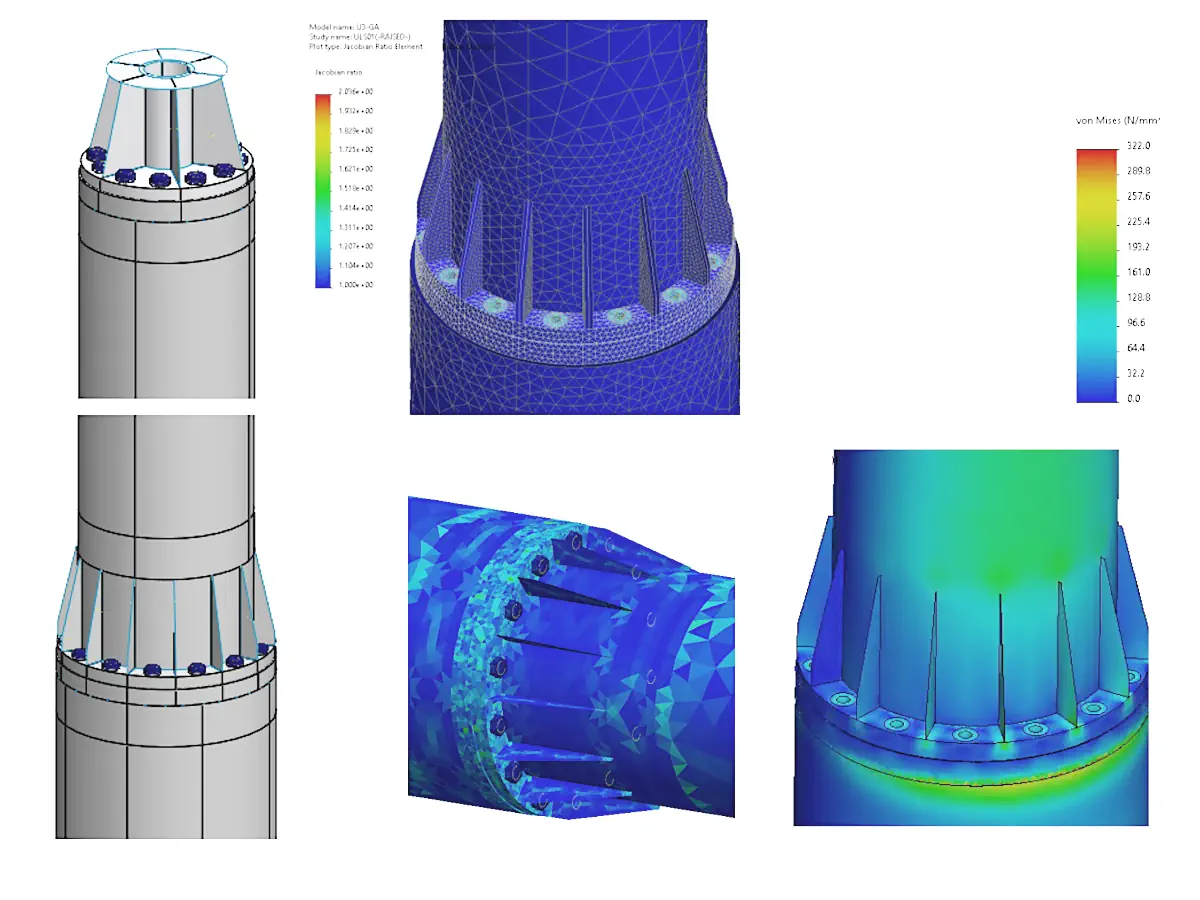
Cropped FEA model views, showing mast shell geometry, mesh quality checks and example stress results.
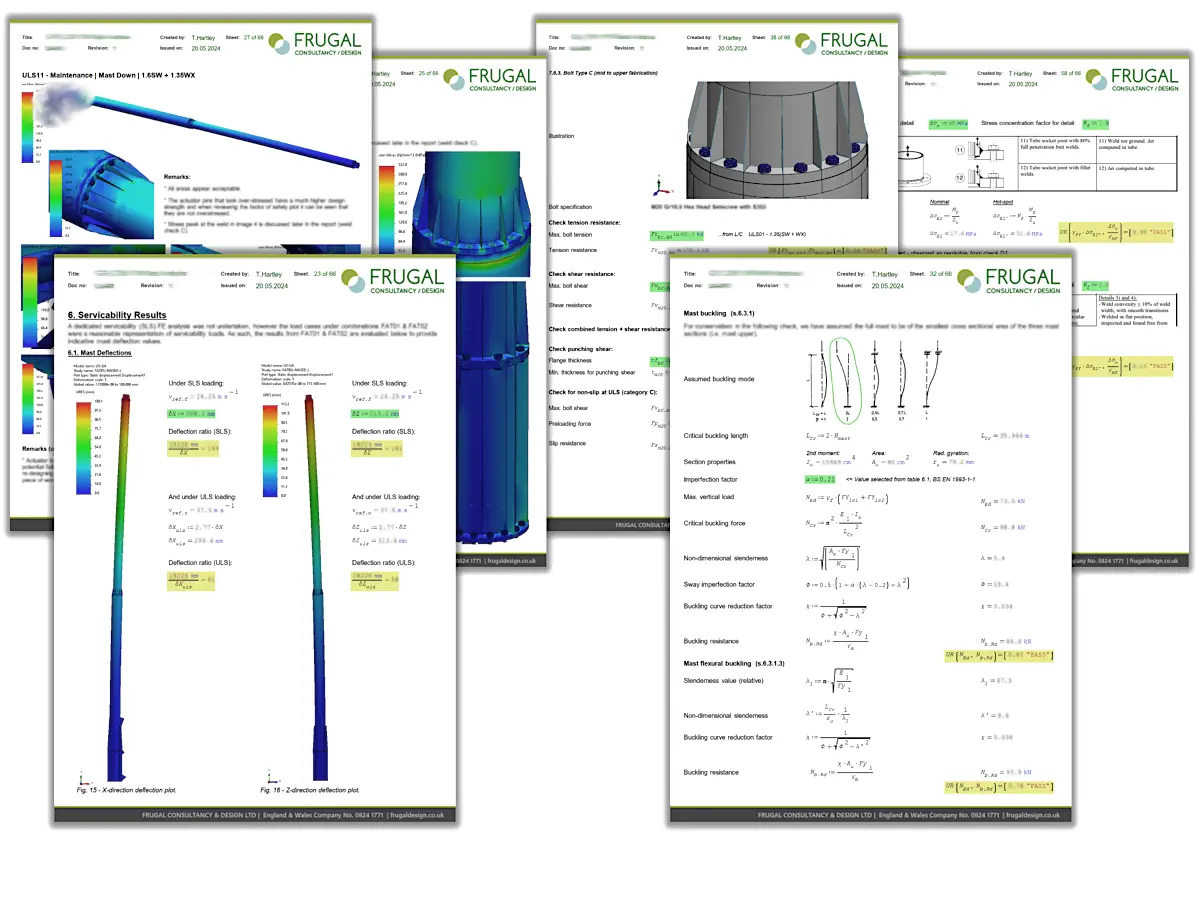
Selected extracts from the structural substantiation report.
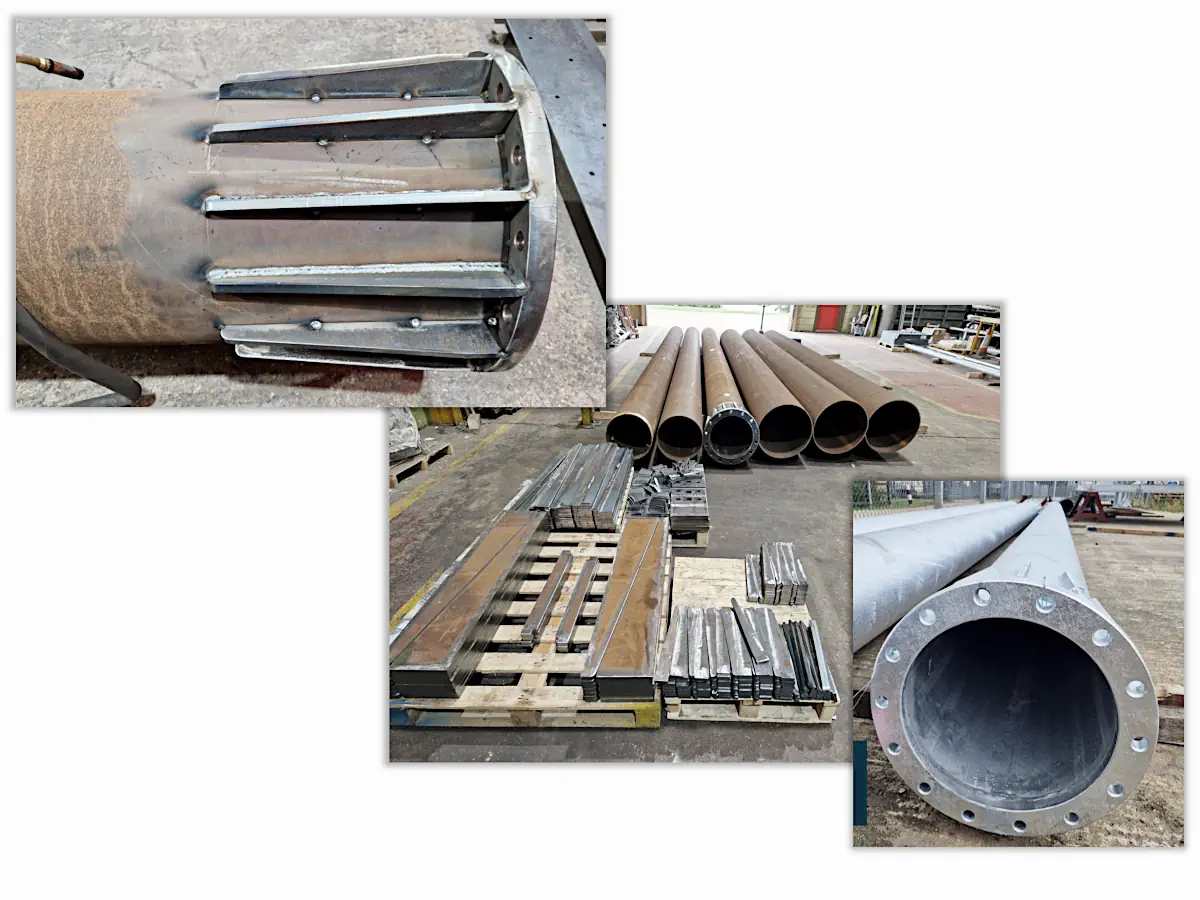
Fabricated mast sections and connection details during manufacture, before and after finishing.
Outcome
What this enabled
Business perspective
The client engaged constructively with the findings, revised the design in response to first-pass failures, and ultimately relied on the work to support design review and move forward with procurement and manufacture on a better-informed basis.
Based on archived project emails
Contact
If you need to solve a problem and you’d like to explore whether I can help, drop me an email:
What to include
To help me give you a useful reply, please mention…
- What you’re building or dealing with (one or two sentences)
- What’s going wrong, what decision you’re trying to make, or where the brief still feels unclear
- Key constraints (budget, timescale, materials, interfaces, standards)
- What information you already have (CAD, drawings, photos, etc)
- Desired outcome (e.g. clearer brief, options report, CAD, calcs, FEA)
- Any deadlines and why they exist (so I can reality-check them)
Attachments
Attachments are welcome:
- All enquiries and attachments are treated as confidential by default
- If attachments are over 2MB, please use a file-sharing service such as Dropbox or WeTransfer and include a download link.
What happens next?
I’ll usually reply with a quick fit-check…
If it's a fit, I will:
- Tell you whether and how I can help
- Give you some options for how we could move forward
- Ask for the minimum info needed to clarify and scope it
If it's not a fit, I will:
- Say so, and tell you why
- Suggest an alternative route, if appropriate