
Case Study

In-house design capability: establishing a design-development system for ISO 9001 certification

Tom devised and implemented the design systems, controls, and supporting documentation that allowed Thorworld to establish a controlled in-house design-development function, with a process robust enough to support ISO 9001 certification for design and development.

Phase 0

Materials handling equipment

Design systems

ISO 9001 design development

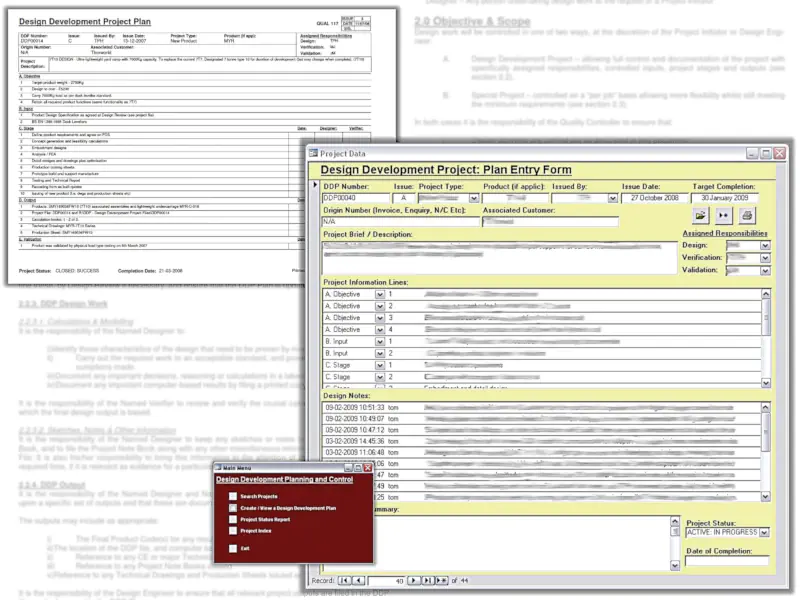
Example records from the design control system

Example records from the design control system

Situation

A manufacturing business with established production capability wanted to stop relying so heavily on external design consultants and begin developing products in-house.

At the time, Thorworld’s quality system covered manufacture, but not design and development. To make an internal design function viable, the business needed more than a designer. It needed a workable design-management system: one that suited the size and practical reality of the company, integrated with how information was already handled internally, and could stand up to external audit.

Tom was tasked with devising and implementing that system, then putting in place the documentation, records, and controls needed to make it operable in day-to-day use.

The real problem

The real problem was not writing a few procedures. It was designing and implementing a complete, proportionate in-house capability to enable product development that was actually planned, controlled, recorded, reviewed, and released in line with relevant quality standards.

That meant translating ISO 9001 design-development requirements into something practical: a process that defined how projects would be initiated, what inputs had to be captured, how reviews and approvals would work, how design changes would be controlled, what constituted outputs, and how verification, validation, and compliance evidence would be recorded.

There was also a substantial implementation challenge. Legacy design information had to be brought under control, new templates and records had to be created, and the system had to interact sensibly with the firm’s wider ways of working rather than sit as an isolated paperwork exercise.

Constraints

  • The system had to fit the business, not just the standard: It needed to be robust enough for certification, but practical enough for a modest-sized manufacturer to use consistently.

  • No inherited in-house design framework: The company had experience manufacturing products, but not running its own formal design-development function, so the system had to be built from first principles.

  • Integration with existing business activity: Elements of the process had to align with existing documentation, personnel responsibilities, and stock or project-related information flows.

  • Legacy information had to be absorbed: Historic design data and existing product knowledge needed to be transferred into the new system in a controlled and usable way.

  • External scrutiny was built in: The process and documentation had to stand up not only to internal use, but also to review by an external QMS consultant and later certification audit.

Client:

Thorworld Industries

Role:

Design Engineer

Period:

2005–2007

Scope:

Design-development system setup +
QMS process definition +
Templates, records, and project controls

Acceptance basis:

ISO 9001 design-development reqs +
External QMS consultant review +
Certification audit readiness

Key moves

Put the right design toolchain in place

  • Reviewed the limitations of the company’s existing 2D Autodesk Mechanical Desktop setup as a basis for internal product development
  • Compared alternative 3D CAD and structural-analysis platforms, then recommended and implemented SolidWorks and Multiframe 4D as the new core platforms

Define a workable design-control model

  • Wrote the company’s design-development approach into the QMS, translating ISO 9001 requirements into a practical internal operating model
  • Defined a clear distinction between validated standard product baselines and controlled “special” variants, so technical-file effort stayed proportionate to the extent of change

Build a design-control system for live design work

  • Designed and coded an MS Access / VBA-based design-development planning system to control projects, records, and technical-file creation
  • Structured it around planning, review, change control, and evidence retention following BS 7000, ISO 9001, and ISO 10007 approaches

Capture the technical file as the design develops

  • Put in place a workflow that captures sketches, calculations, and early-stage development work as the work is done
  • Ensured that concept development and supporting reasoning were retained within the technical file rather than lost once products reached release

Bring legacy information under control

  • Planned and delivered a prioritised transfer of existing design data into the new system, improving file quality and consistency as it progressed
  • Used that migration not just to copy information across, but to review and strengthen the technical-file baseline for standard products

Prove and refine the system through live use

  • Used early in-house development projects to test and tune the software setup, templates, workflows, and interactions with costing, planning, and stock systems
  • Worked with the company’s external QMS consultant during setup, then supported the first independent ISO 9001 audit as the first real external validation of the new function

Outcome

Tom devised and implemented a fully workable in-house design-development function within the business, where more substantial product development work had previously relied on external consultants.

The new system did not just exist on paper. It was put into live use, integrated with the company’s wider operations, and taken through its first external ISO 9001 audit for design and development. Although some comments or discrepancies had been expected on a first attempt, the audit returned only one minor comment, with no discrepancies or major issues. That result gave the business strong early confirmation that the new department and its supporting systems had been set up on a sound footing.

What this enabled

The business was able to move from manufacture-only quality-system coverage to full ISO 9001 certification including design and development, where its earlier ISO 9002 position had only covered manufacture.

That significantly changed what the company could do internally. It gave the business far greater capacity, flexibility, and cost-effectiveness in product development, reduced reliance on external consultants for in-depth design work, and created a platform for faster improvement of existing products as well as more active development of new ones for the catalogue.

Business perspective

No formal testimonial has been retained for this work. However, the new design function was adopted into live use, the external QMS consultant was satisfied with the system that had been put in place, and the first independent audit of the design-development process returned only one minor comment with no discrepancies or major issues. Internally, that result appears to have materially increased confidence in the new in-house design capability.

Based on recollections from the time

Contact

If you need to solve a problem and you’d like to explore whether I can help, drop me an email:

What to include

To help me give you a useful reply, please mention…

  • What you’re building or dealing with (one or two sentences)
  • What’s going wrong, what decision you’re trying to make, or where the brief still feels unclear
  • Key constraints (budget, timescale, materials, interfaces, standards)
  • What information you already have (CAD, drawings, photos, etc)
  • Desired outcome (e.g. clearer brief, options report, CAD, calcs, FEA)
  • Any deadlines and why they exist (so I can reality-check them)

Attachments

Attachments are welcome:

  • All enquiries and attachments are treated as confidential by default
  • If attachments are over 2MB, please use a file-sharing service such as Dropbox or WeTransfer and include a download link.

What happens next?

I’ll usually reply with a quick fit-check…

If it's a fit, I will:

  • Tell you whether and how I can help
  • Give you some options for how we could move forward
  • Ask for the minimum info needed to clarify and scope it

If it's not a fit, I will:

  • Say so, and tell you why
  • Suggest an alternative route, if appropriate

Email me directly at:

hello@frugaldesign.co.uk
Compose email